
Event Recap: Australia-EU FTA: Key Takeaways for Dutch-Australians
“How will the Australia-EU FTA reshape opportunities for Australian-Dutch businesses?” That was the question at a landmark webinar on Tuesday, 24 February, where business leaders, diplomats, and trade experts gathered to discuss the Australia–European Union Free Trade Agreement (FTA) - an agreement set to reshape the landscape for international trade and investment.
The webinar was historic, marking the first time all Dutch chambers in Australia joined forces for a single initiative. The session was framed as an opportunity to explore the practical and strategic implications of the FTA for Australian-Dutch businesses, while drawing lessons from the FTA for New Zealand - European Union.
Key Insights

Martijn Bakker, Vice President of the Dutch Business Association New Zealand, shared insights from the EU–New Zealand FTA, the fastest EU trade agreement ever negotiated. Entering into force on 1 May 2024 after four years and 12 negotiation rounds, the agreement delivered immediate tariff reductions. 91% of New Zealand exports to the EU were tariff-free from day one. Bilateral trade grew 8% in the first year, with goods exports increasing by 28% and services by nearly 12%, adding NZD 300 million in trade value.
Bakker highlighted the Indigenous and sustainability provisions, noting that it was the first EU trade agreement to include an Indigenous chapter, recognizing the Treaty of Waitangi, reflecting Māori economic interests (9% of GDP) and embedding Indigenous perspectives across sustainability, digital trade, and food systems. This all aligns well with European circular economy principles and transforms these provisions from symbolic to structural and essential elements of trade policy.
He also highlighted the sustainability and rules of origin framework as a competitive advantage rather than a barrier. By ensuring compliance with environmental standards, including forestry, agriculture, and greenhouse gas emissions, the FTA enables businesses to market high-quality, sustainably produced goods to European consumers, opening new growth opportunities.
“This is a gateway for growth and for higher production, and more export”
Finally, he stressed the importance of implementation and SME engagement. Advisory groups, toolkits, and clear guidance make it easier for smaller companies to navigate the FTA, while visa and labor provisions facilitate mobility for skilled workers, allowing businesses to expand operations across jurisdictions. Practical initiatives like the New Zealand–Europe Business Summit demonstrate how structured support enables companies to capitalize on the FTA’s benefits from day one.
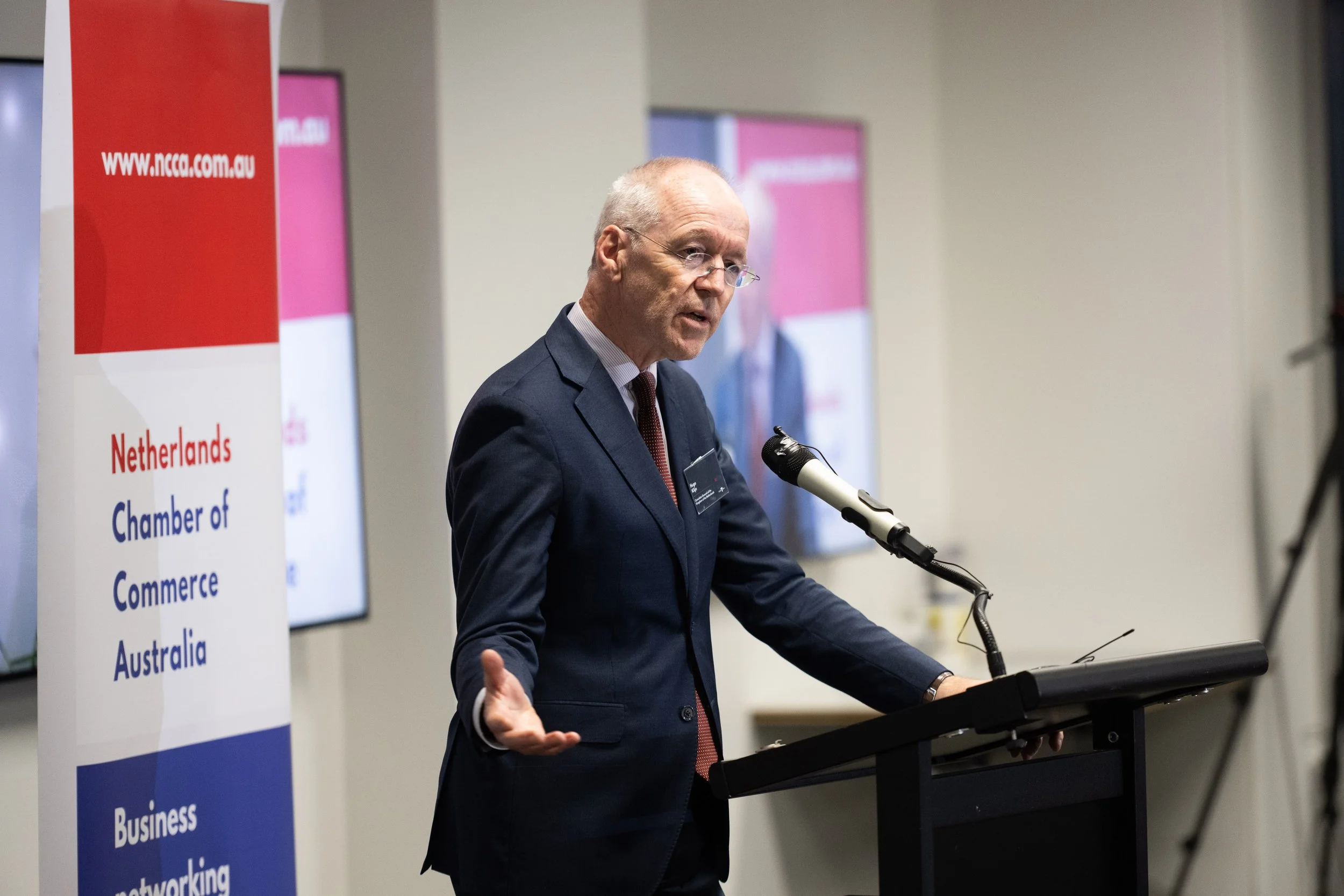
Hugo Klijn, Consul General of the Netherlands, provided a candid look at the challenges and opportunities of the Australia–EU FTA. He noted that while negotiations must navigate complex issues such as agricultural quotas, labor mobility, and government procurement, the agreement promises to remove virtually all industrial tariffs, improve services market access, and facilitate investment. Klijn highlighted that the FTA would diversify Australia’s export markets away from China, strengthening trade resilience. For Australian-Dutch businesses, this translates to enhanced market certainty, improved investment prospects, and access to large-scale EU projects.
“Against the backdrop of current developments in the world, it would partner two like-minded export orientated economies that value a rules-based international Trade so a perfect win-win as far as the Netherlands is concerned.”

Simon Kuestenmacher, demographer and keynote speaker, explored Australia’s economic strengths and export profile. He described Australia’s “outrageously simplistic business model,” focusing on the four pillars of mining, agriculture, tourism, and education. He argued that the FTA could open new markets for goods, talent, and services. Kuestenmacher emphasized the strategic value of the FTA in helping Australia diversify its export base, particularly in sectors like beef, iron ore, and high-value services, while maintaining a stable economic and political environment for investment.
“We [Australia] just want market access and it fits into the narrative of an explicit policy goal of Australia to diversify the export basket”
Australia is facing significant workforce pressures due to several demographic and educational trends. Around 55% of Year 12 students now go on to university, which means that many young Australians delay their full participation in the workforce until their mid-20s. As a result, a large portion of the population is “on campus” for multiple degrees, which slows the flow of skilled workers into the labour market. At the same time, a large group of Millennials in their 30s are having children, creating another factor that temporarily removes people from the workforce through parental leave over the next decade.
These two trends, delayed workforce entry and temporary exits, are drawing workers away from the labour market, contributing to existing pressures on workforce availability. Migration currently plays a key role in supplementing the Australian workforce.
Overall, these demographic factors, education timelines, parental leave patterns, and migration levels, combine to create ongoing workforce challenges, with fewer workers available at scale and later entry into skilled roles. Kuestenmacher emphasizes that these dynamics are already shaping the labour market and will have important implications for workforce planning and productivity in Australia.
Key Takeaways for Australian-Dutch Businesses
For Australian-Dutch businesses, the FTA presents a historic opportunity. The agreement is expected to expand market access, remove tariffs, and provide regulatory clarity. Sustainability and circular economy provisions, rather than creating barriers, are likely to become market enablers, helping high-quality Australian products gain competitive advantage in Europe.
1. Strategic Opportunity from the FTA
The FTA is seen as a historic and highly relevant development, offering new opportunities for Dutch-Australian businesses for expanding trade, investments, and collaboration
The FTA is expected to remove most industrial tariffs, improve services market access, and facilitate regulatory approvals, making it easier for businesses to operate across both regions
2. Lessons from the EU-New Zealand FTA
The New Zealand-EU FTA, which is already in force, has led to significant increases in trade volumes and regulatory certainty. Dutch exports to New Zealand (mainly machinery, transport equipment, and services) have grown, with tariffs on many goods eliminated immediately
The experience suggests that Dutch-Australian businesses should prepare for similar benefits and regulatory frameworks, particularly in machinery, services, and sustainable sectors.
3. Market Access and Diversification
Australia is actively seeking to diversify its export markets, reducing reliance on, for example, China. The FTA with the EU is a key part of this strategy, offering Dutch-Australian businesses access to a large, stable European market
The Netherlands is already the top EU investor in Australia, and the FTA is expected to further facilitate investment flows and joint ventures
4. Public Procurement and Services
The FTA will open up public procurement, allowing Dutch and EU firms to bid on Australian government contracts on equal footing with local suppliers. This is particularly relevant for sectors like infrastructure, transport, IT, and consultancy
5. Sustainability and Indigenous Engagement
The agreement emphasizes sustainability, circular economy, and compliance with the Paris Agreement. Dutch-Australian businesses with strong sustainability credentials will have a competitive advantage
There is also a focus on indigenous engagement and protection of geographical indicators (GIs), which may influence branding and product protection strategies.
6. Demographics and Skills
Australia’s growing and youthful population, driven by migration, creates a strong consumer market and demand for skilled workers. Dutch businesses offering productivity-enhancing products, technology, or services are well-positioned to benefit
Skills shortages are a persistent challenge, so businesses that help address these gaps (e.g., through automation, training, or technology) will find strong demand.
7. Remaining Challenges
Some sticking points remain, such as agricultural quotas (especially beef), geographical indications, and labor mobility. However, the overall environment for concluding the FTA is seen as positive and increasingly urgent
8. Practical Steps
Businesses are encouraged to engage with chambers, leverage available toolkits, and stay informed as the FTA is finalized. Collaboration and information-sharing will be key to maximizing benefits
As the Australia–EU FTA moves closer to ratification, the consensus from the webinar was clear: this is a pivotal moment for Australian-Dutch trade, offering a structured, sustainable, and highly strategic pathway for growth. For companies positioned to act, the message was unmistakable—history is on the horizon.
Speakers and Supporters
This Webinar was supported by the Consulate-General of the Kingdom, the Netherlands, Dutch SA, Dutch Business Association NZ, Netherlands Chamber of Commerce Australia, Dutchlink, Dutch Chamber of Commerce Queensland, Australian Dutch Business Council, and Consentrade International.
Hugo Klijn, Consul General of the Kingdom of the Netherlands
Martijn Bakker, Vice President of the Dutch Business Association NZ and NZ Europe Business council
Simon Küstenmacher, Co-Founder and Director at The Demographics Group
